My custom PC build
From hand-me-down hardware to a custom build that became my gaming rig, my test bench and, today, a cloud game hosting server.
- Ryzen 7 5700X
- RTX dGPU
- Liquid cooling
- SSD and HDD array
- Windows 11 LTSC
- Rocky Linux 10
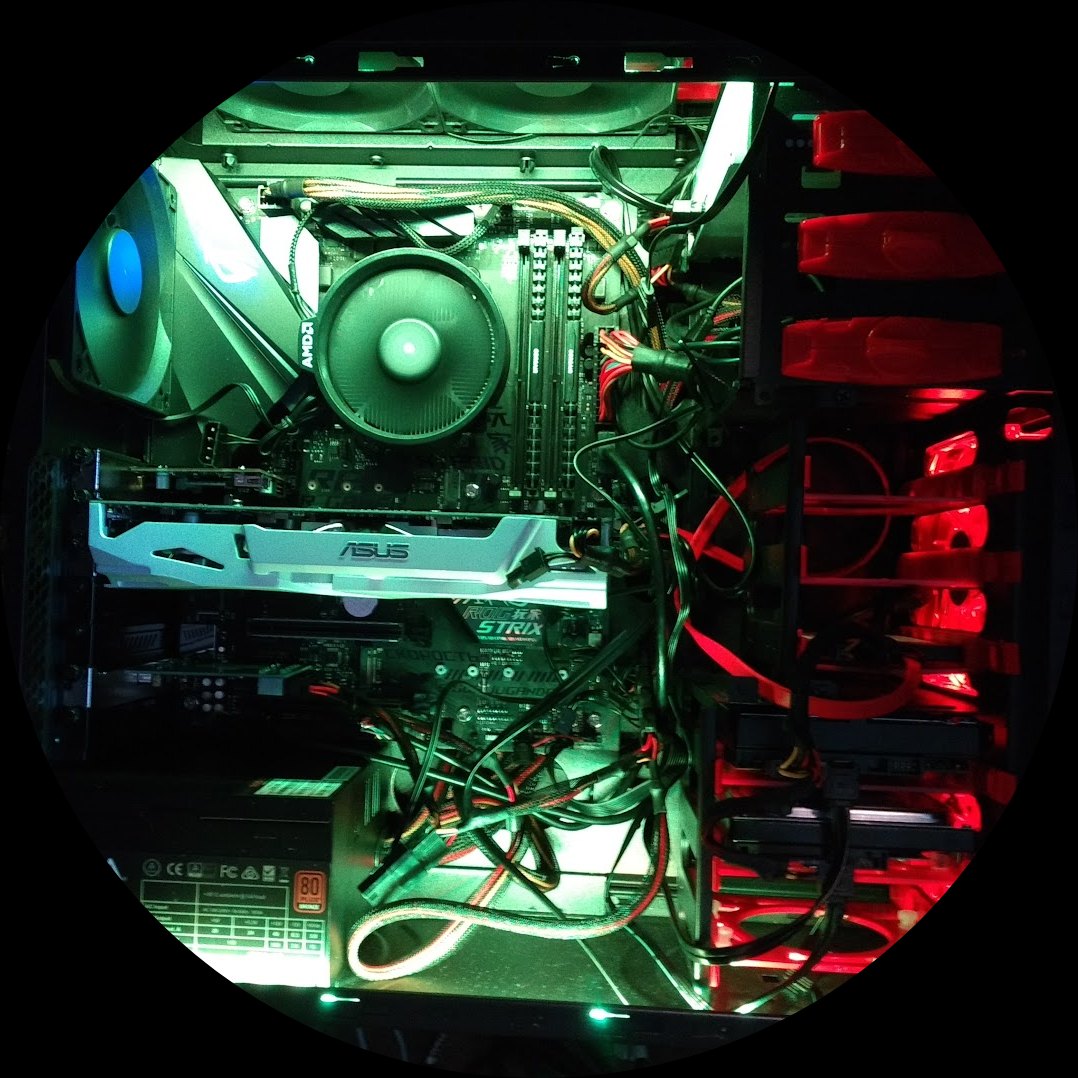
Before this build I got by on netbooks, secondhand and refurbished desktops, laptops, tablets and a transformer book. Eventually I decided to build my own: a gaming and learning PC from off-the-shelf parts, picked up from a handful of retailers.
Version one
- Deepcool Kendomen case with 9 cooling fans, counting the GPU
- 600 W power supply
- Ryzen 5 2600 (6 cores, 12 threads, 3.4 GHz)
- Asus Dual GeForce card with 6 GB of GDDR5
- 32 GB of RAM at 2,666 MHz
- 2 TB M.2, a 1 TB SATA SSD and a 2 TB 5,400 RPM hard drive
- Multiboot: Windows 10 Enterprise, Kubuntu 20.04 and a macOS virtual machine
What it was really for
Gaming, sure. Mostly, though, it was a test bench: driver troubleshooting, older Windows versions in VMs, macOS experiments, Debian- and Arch-based distributions, custom OS builds like Android x86, sysadmin practice, remote access, open-source software, Android configuration over ADB, coding, OS customization, third-party wireless and USB cards, and more UEFI tweaking than is probably healthy.
The upgrades
- CPU: Ryzen 7 5700X (8 cores, 16 threads), overclocked to 4.6 GHz, with liquid cooling once the original cooler could not keep up
- GPU: an RTX dGPU, for VR and better 2K and 4K gaming
- Storage: expanded into an array of SSDs and HDDs
- Boot menu: went through Windows 11 Pro, Pop!_OS 22.04 LTS and a legacy Windows 10 Enterprise install along the way
Where it is now
macOS has been my daily driver since 2022, so the gaming PC got a new job: it is now a cloud game hosting server in my homelab. Same hardware, new role.
Today it dual-boots Windows 11 Enterprise LTSC 24H2 and Rocky Linux 10: LTSC for long term stability on the Windows side, and a RHEL-compatible distribution on the Linux side.